How do you play Block Blast?+
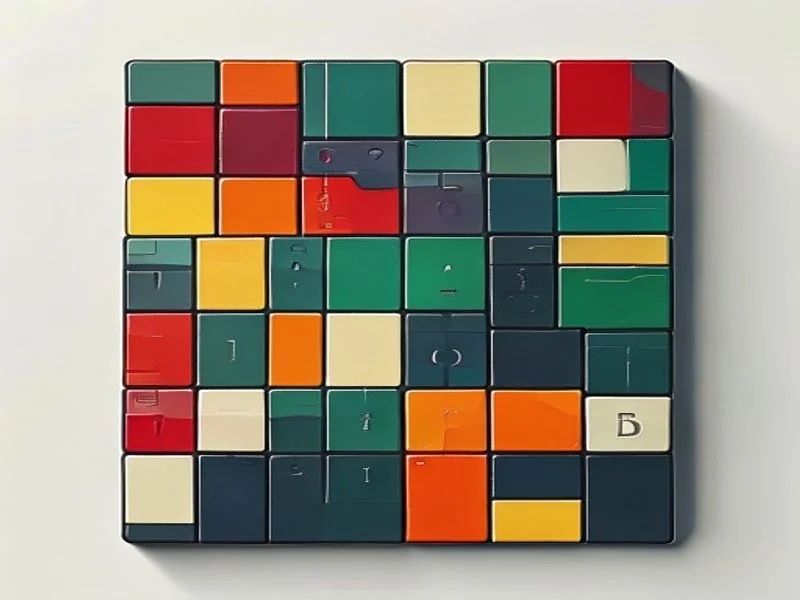
Click or tap any block that is part of a connected group of 2 or more same-colored blocks (orthogonal only). The whole group clears, blocks fall, and empty columns shift left. Keep clearing until no groups of 2+ remain.
What is the scoring formula?+
You score the square of the number of blocks you clear in one group. A group of n blocks is worth n² points. So a 3-block group gives 9, a 5-block group 25, and a 10-block group 100 points.
Why do bigger groups score more?+
Scoring uses groupSize squared, so points grow quadratically, not linearly. Clearing one 10-block group (100 pts) beats clearing five 2-block groups (20 pts). Size is the single biggest factor in a high score.
How does gravity work after a clear?+
When a group vanishes, every block above the gap falls straight down to fill the empty space, preserving column order. Nothing moves sideways from gravity alone — only the vertical drop happens automatically.
When do columns shift left?+
After gravity, any column that has become completely empty is removed and the columns to its right slide left to close the gap. This keeps the board compact with no empty columns on the sides.
What ends the game?+
The game ends when there is no longer any orthogonally connected group of 2 or more same-colored blocks left on the board. Whatever singletons remain are un-clearable, and your final score is locked in.
What is the best strategy to score high?+
Grow groups before clearing, clear from the bottom to trigger cascades, and avoid leaving singletons. Plan a couple of moves ahead and let gravity merge colors into bigger groups for squared-point payoffs.
How is Block Blast different from match-3 games?+
Match-3 games require you to swap tiles to line up exactly three. Block Blast needs no swaps — you click whole connected groups of any size and they clear, with gravity plus leftward column collapse.
Is Block Blast endless?+
No. Each board is finite (10×12), and play ends once no group of 2+ same-colored blocks exists. Your run is a single board you try to maximize, not an infinite stream of levels.
How many colors are used?+
The board uses a small set of distinct block colors (typically four to six) so that adjacent same-colored groups form regularly. Fewer colors mean more frequent large groups and higher scoring potential.
Can I play Block Blast on mobile?+
Yes. The game is touch-friendly: simply tap any block in a valid group to clear it. The board, gravity, and scoring behave identically to the desktop version, so it plays well on phones and tablets.
What are the best tips for beginners?+
Start by spotting the largest group and clearing it, clear from the bottom to cause drops, and never strand a single block. Keep colors together so gravity can reconnect them into bigger, higher-scoring groups.
What games are similar to Block Blast?+
It is in the same family as SameGame, Clickomania, and Tetris-attachment puzzles. Any game about removing connected same-colored clusters with gravity and collapse shares Block Blast's core loop.
Is there a difficulty setting?+
Difficulty comes from the board's random color layout rather than selectable levels. Some boards naturally allow huge cascades; others force careful planning to avoid early singletons. Each new board is a fresh puzzle.
Is Block Blast accessible?+
The game relies on color and click/tap input. Because groups are identified by color, players with color vision deficiency may find it harder; high-contrast palettes and clear block borders help, and only a single click is required per move.
Can a single block ever be cleared?+
No. Only groups of 2 or more orthogonally connected same-colored blocks can be removed. A block with no matching neighbor is a singleton and will remain on the board until the game ends.
Does clearing cause chain reactions?+
Yes. After a clear, gravity and column collapse can bring same-colored blocks together, forming new groups you can immediately clear. Chaining these cascades is the key to very high scores.
What does the score counter show?+
The score counter shows your running total — the sum of every group you have cleared, each worth its size squared. It updates instantly after every move so you can see the impact of each clear.
How big is the board?+
The board is 10 columns wide and 12 rows tall, giving 120 blocks to work with. That size is large enough for big cascades but small enough to plan a few moves ahead comfortably.
Where can I learn advanced strategies?+
Our complete guide and advanced combos article cover building big groups, engineering cascades, and planning column shifts. The core idea is always the same: maximize group size and let gravity do the work.