How do you play Masterpieces?+
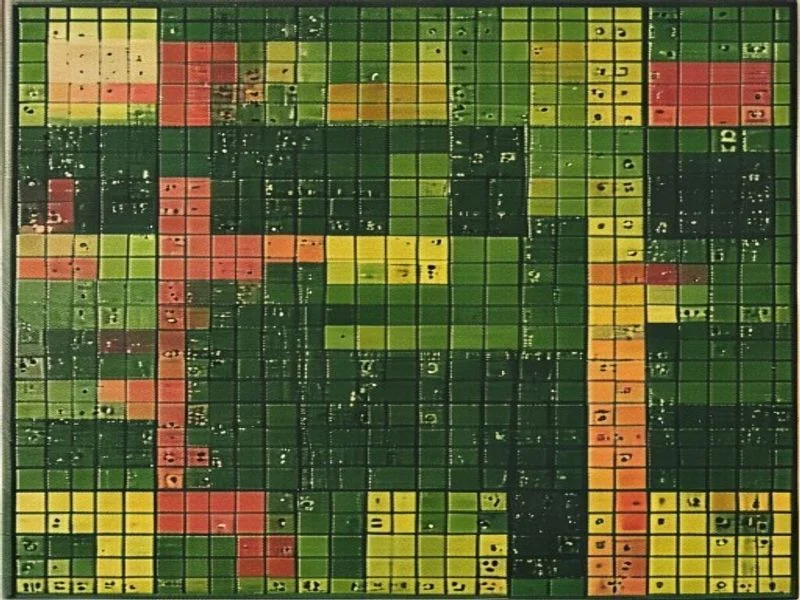
You are given a target symmetrical pattern and a palette of colored blocks. Place blocks onto the grid to recreate the pattern exactly. Rotate blocks when needed, remove wrong placements, and finish within your move budget to earn the best score.
What is a symmetrical pattern?+
A symmetrical pattern mirrors itself across at least one axis — usually vertical, horizontal, or both. That means half of the puzzle is a perfect reflection of the other half. Use that symmetry to solve faster by working from the center outward.
How does rotation work?+
Some blocks are marked as rotatable. Click or tap a rotatable block in your palette, then click the rotate control to turn it 90 degrees before placing it. Once placed, rotation is no longer possible without removing the block, which costs a move.
What happens if I run out of moves?+
If your move budget reaches zero before the pattern matches exactly, the level ends and you earn a score based on your accuracy. You can restart the level to try a different strategy or faster placement sequence.
How is scoring calculated?+
Scoring combines three factors: how many cells are correct, how many moves remain unused, and how quickly you finish. A perfect run with the full budget intact and all cells matched gives the highest possible score, which is tracked as your local best.
Do I need artistic skill to play Masterpieces?+
Not at all. The game is a logic puzzle, not a drawing tool. You match colors to predefined cells, and the symmetry hints remove guesswork. Pattern recognition and spatial planning are more useful than artistic talent.
Is there a timer in Masterpieces?+
Yes, each level runs on a limited move budget rather than a countdown timer. You are not rushed by a clock, but you are encouraged to place blocks efficiently so you finish with moves remaining for a better score.
Can I play Masterpieces on mobile?+
Yes. The board and palette are touch-friendly with large tap targets. Tap a block, then tap a cell to place it. Rotation is handled by a dedicated button so small-screen play feels natural.
What difficulty levels exist?+
Puzzles range from 3×3 grids for beginners to 7×7 grids for experts. Early levels use only four colors and no rotation; later levels introduce more colors, mixed rotations, and tighter move budgets.
Why does symmetry matter?+
Symmetry cuts the effective problem size in half. If the target mirrors across its center, solving the right half automatically defines the left half. Experienced players use this to reduce their move count and earn higher scores.
Can I undo a placement?+
Yes. Click or tap a placed block to remove it and return it to your palette. This costs one move, so use undo sparingly and plan placements carefully to avoid wasting your budget.
Is Masterpieces good for kids?+
Yes. The rules are simple, the color palettes are bright, and the symmetry concept teaches early geometry and pattern recognition. Children can start on small grids and work up to larger symmetrical puzzles as their planning skills grow.
What if I cannot see the mirror axis?+
The target pattern is always clearly symmetrical across one axis. If you are unsure which axis to use, look for the row or column where colors repeat in reverse order. That is your mirror line. Center blocks lie exactly on the axis and never move.
How does the best score system work?+
Your best score for each level is saved locally. Try to beat it by improving your accuracy and reducing moves. The scoreboard only tracks your own progress, not other players.
What is a perfect run in Masterpieces?+
A perfect run places every block correctly on the first try, uses fewer than half of the available moves, and leaves the full compliment of unused blocks in your palette. Reaching this earns the maximum reward and five stars on the level summary.
What games are similar to Masterpieces?+
Fans of Masterpieces often enjoy nonogram puzzles, color-matching games, and Tetris for their spatial logic. The symmetries and block planning also echo classic jigsaw puzzles and origami instructions.