Why Compare Three Timing Games?
Timing games get lumped together because they all punish a mistimed click. Under that surface they ask for very different things from your brain. Stack Tower rewards a single clean tap at the right instant. Color Match asks your eyes to judge a subtle difference before a clock runs out. Match the Feel layers speed on top of sorting and dragging. If you are picking a game for a five-minute warm-up, the difference matters more than you might expect.
This piece puts the three side by side so you can decide what you actually want to practice. None of them requires an account or a download, and all three run in the browser, which is exactly why they show up in the same casual corner of most game collections. The interesting part is not which is best in the abstract, but which is best for the skill you are trying to sharpen on a given day.
What Counts as a Timing Game?
A timing game is any title where the moment you act matters as much as the action itself. Reaction speed is part of it, but so is anticipation, judgment under a deadline, and the discipline to wait rather than grab. A pure reaction test, like a "press when the light turns" drill, is narrow. A good browser timing game usually blends reaction with a second demand, reading a pattern, judging a color, or placing a piece, so the timing sits inside a slightly richer task.
That blend is what makes these games useful as warm-ups. They wake up the same systems you use for focused work: visual tracking, decision-making under mild pressure, and fine motor control. The trick is matching the game to the kind of wake-up you need. A game that overloads your eyes is a poor choice right before you need to read; a game that rewards calm rhythm is a better pre-writing primer.
Timing games are not a substitute for rest. Used for a few minutes they can sharpen focus; used for an hour they just tire the same pathways. Treat them like a stretch, not a workout.
Stack Tower: Precision Under Rising Speed
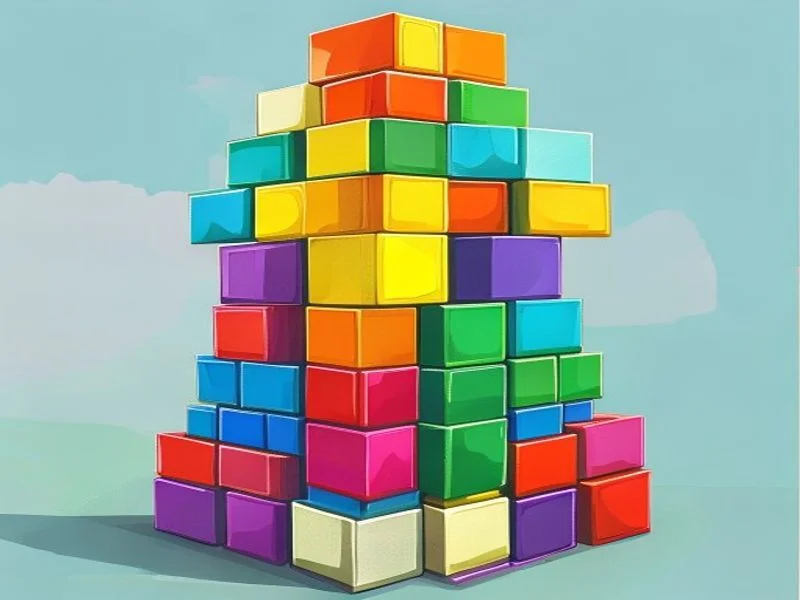
Stack Tower is the purest of the three when it comes to timing. A block slides left and right across the top of the screen, and one click or tap drops it. Whatever overhangs the block below is sliced away, so the next block inherits only the width of the overlap. Land centered and the tower stays wide; land off-center and every future drop gets harder.
The skill it trains is anticipatory timing. You are not really reacting to a sudden event, you are judging the midpoint of a swing and committing to a tap slightly before the visual lineup looks perfect. That is a harder and more useful habit than pure reflex, because it removes reaction delay. As the speed climbs each level, the margin for hesitation shrinks, which is exactly why experienced players pre-commit rather than wait for the perfect frame.
What Stack Tower does not train is perception of detail. There is one color, one shape, and a clear target line. The challenge is rhythm and steadiness, not discrimination. If your goal is to calm a jittery hand before precise work, this is the strongest pick of the three.
Color Match: Perceptual Timing
Color Match flips the demand. Instead of dropping a block, you reproduce a target color with sliders and a ticking clock. The closer your mix, the higher the score. The timer is short, so the game becomes a race between your eyes and the countdown.
This trains a different kind of timing: the speed at which you can perceive and decide. You are not tapping on a rhythm, you are deciding "is this swatch close enough to commit, or do I nudge one channel?" That decision under deadline is where the timing lives. Players who freeze and re-read the target ten times score worse than players who decide once and commit, even if the match is slightly imperfect.
Color Match also exercises color discrimination, which the other two games do not touch at all. If your work involves design, photography, or any color-sensitive task, this is the better pre-session primer because it wakes up the exact perceptual channel you are about to use. It is a poor choice if your eyes are already tired, since it leans directly on visual acuity.
Match the Feel: Drag-and-Drop Timing
Match the Feel sits between the other two. Colored shape tiles sit in a palette at the bottom, and you drag each one to its matching target zone before the countdown ends. Correct drops score points and build a combo multiplier; wrong drops bounce back and break the streak.
The timing here is about throughput under pressure. You must scan several targets, choose the easiest match, execute a precise drag, and keep the combo alive, all while a clock drains. That makes it the most "busy" of the three. It trains hand-eye coordination and rapid sorting more than pure anticipatory timing, and the combo system adds a light strategic layer about when to play safe versus fast.
Because it involves dragging rather than a single tap, Match the Feel is also the most physically active on a touchscreen. If you want a game that exercises coordination and decision-making together, this one covers the most ground, at the cost of being the least meditative of the set.
Direct Comparison
The table below lays the three out on the dimensions that actually differ. "Timing type" is the shortest way to see what each one asks of you.
| Dimension | Stack Tower | Color Match | Match the Feel |
|---|---|---|---|
| Core timing type | Anticipatory, rhythmic tap | Perceptual decision speed | Throughput under pressure |
| Primary skill trained | Steady precision tapping | Color perception + quick judgment | Coordination + fast sorting |
| Input style | One tap or click per block | Slider adjustments, then commit | Drag and drop shapes |
| Visual load | Low, single color and shape | High on color acuity | Medium, multiple shapes |
| Pressure source | Rising block speed | Short countdown | Countdown plus combo |
| Best used as | Calm pre-focus warm-up | Perception primer for visual work | Active coordination drill |
| Difficulty curve | Smooth, speed-based | Sharp, detail-based | Steady, combo-based |
Notice that no single row makes one game "better." They are better at different things. The row that should drive your choice is "best used as," because that is the only one tied to a real outcome you can feel after playing.
Quick summary: Stack Tower trains steady anticipatory tapping, Color Match trains fast color judgment, and Match the Feel trains coordinated sorting under pressure. Pick by the skill you want awake, not by which looks simplest.
Which Game Trains What
If the question is purely "which one makes me quicker," the honest answer depends on what kind of quick. For finger-tap precision and a calm, repeatable rhythm, Stack Tower is the cleanest trainer. For visual discrimination speed, Color Match is unmatched among the three because it is the only one built around perception. For coordinating eyes, hands, and fast decisions together, Match the Feel covers the broadest set of demands.
A useful way to think about it is by mental channel. Stack Tower is a motor-and-timing channel. Color Match is a perception channel. Match the Feel is a coordination-and-execution channel. Most people rotate between channels through a normal day, so rotating games to match is reasonable. Do not assume the "hardest looking" game trains the skill you need; Match the Feel feels busy but barely touches color perception at all.
The right timing game is the one that warms up the channel your next task uses. A designer should reach for Color Match; someone about to do careful data entry should reach for Stack Tower.
Using These Games as a Warm-Up
A warm-up works best when it is short and intentional. Two or three minutes is plenty. The goal is to shift your nervous system into "alert but calm," not to chase a high score. If you find yourself frustrated, you have gone past warm-up into practice, and that is a different activity with different value.
- Pick the game whose trained channel matches your next task.
- Set a hard stop of three minutes so you do not drift into a session.
- Focus on smooth, repeatable actions rather than a personal best.
- Stop the moment your attention feels sharpened, not tired.
This routine sounds trivial, but the discipline is the point. These games are easy to lose twenty minutes in, and twenty minutes of timing practice defeats the purpose of a warm-up. Treat the timer as part of the game.
Where Block Blast Fits In
It is worth noting that not every quick browser game is a timing game. Block Blast is untimed and rewards spatial planning and patience rather than a well-placed tap. If you reach for it expecting a timing drill, you will be confused, because the skill it builds is lookahead and board management, not reaction speed.
That contrast is useful. Block Blast is the better choice when you want to slow down and think a few moves ahead, the opposite of a warm-up. Stack Tower, Color Match, and Match the Feel all impose a clock or a speed of some kind, which is the line that makes them timing games and keeps Block Blast in a different drawer. Remember the distinction: timing games pressure the moment of your action, while planning games pressure the sequence of your choices.
A Note on Transfer and Expectations
None of these games will make you dramatically faster at unrelated work. The transfer is modest and mostly about arousal and focus, not skill. What they can do is move you from a sluggish state into an attentive one in a couple of minutes, which is genuinely useful before a task that needs care. The bigger risk is the opposite belief, that because a game feels productive you are "working" while playing it. Use it as a bridge between tasks, not a replacement for them.
Choosing Your Default
If you want one game to keep coming back to, let the table decide for you rather than the art style. Players who like a meditative single action tend to stick with Stack Tower, because the loop is so simple it becomes a rhythm you can feel. Players who enjoy a clear perceptual challenge gravitate to Color Match. Players who want a bit of everything in one screen usually prefer Match the Feel. There is no wrong answer, only a mismatch between game and goal, so let the comparison above decide for you rather than the art style.
Put your timing to the test.
Open Stack Tower and try dropping ten blocks centered in a row. If you can hold the rhythm, the other two will feel easy by comparison.
Play NowFrequently Asked Questions
What are the best timing games to play in a browser?
Strong browser timing games include Stack Tower for anticipatory tapping, Color Match for fast color judgment, and Match the Feel for coordinated sorting under pressure. Each trains a different skill, so the best one depends on what you want to practice.
How is Stack Tower different from Color Match?
Stack Tower is a one-tap precision game where you drop a moving block as close to center as possible. Color Match is a perceptual game where you reproduce a target color against a clock. One trains steady tapping; the other trains quick visual judgment.
Does Match the Feel train timing or coordination?
Mostly coordination. You drag shapes to matching targets before a countdown ends, which blends hand-eye control with fast sorting. The timing element is throughput under pressure rather than a single precise tap.
Which game is best for improving reaction speed?
Stack Tower is the closest to a reaction trainer, because success depends on committing a tap at the right instant as block speed rises. Color Match and Match the Feel add perception and coordination layers that dilute the pure reaction demand.
Can these games actually improve focus?
They can help shift you into an alert, calm state for a few minutes, which is useful as a warm-up between tasks. The effect is modest and mostly about arousal, not a lasting skill gain, so keep sessions short.
Is Block Blast a timing game too?
No. Block Blast is untimed and rewards spatial planning and patience rather than a well-placed tap under pressure. It belongs to the planning genre, not the timing genre, even though it is a quick browser game.
Which timing game is best before design work?
Color Match is the better choice before visual work, because it wakes up color perception and quick judgment, the same channels design tasks use. Stack Tower is better before calm, precise input work like data entry.
Are these games good for kids?
Yes. All three are family friendly, have no violence or complex text, and run instantly in a browser. Stack Tower is especially approachable for young children because it needs only a single tap per block.
How long should a timing-game warm-up be?
Two to three minutes is enough. The goal is to sharpen attention, not to chase a high score. Longer sessions tend to tire the same pathways you wanted to wake up, which works against the warm-up.
Do these games get harder over time?
They apply pressure differently. Stack Tower speeds up each level, Color Match shortens its clock, and Match the Feel combines a countdown with a combo system. Each ramps difficulty, but through a different mechanism.
Can I play all three on mobile?
Yes. Stack Tower and Match the Feel are touch friendly with tap and drag controls, and Color Match works with on-screen sliders. All three run in a mobile browser without an install.
Sources & References
- Official Stack Tower game page on the Playables platform for rules and mechanics.
- Official Color Match and Match the Feel game pages on the Playables platform for their timing and scoring rules.
- Wikipedia, "Video game genre" - background on arcade and casual game classification used to separate timing from planning games.

Dev is part of the Playables editorial team. He covers arcade, reflex, and casual games, with a soft spot for timing-based high-score chases and relaxing browser breaks.
Frequently asked questions
What are the best timing games to play in a browser?
Strong browser timing games include Stack Tower for anticipatory tapping, Color Match for fast color judgment, and Match the Feel for coordinated sorting under pressure. Each trains a different skill, so the best one depends on what you want to practice.
How is Stack Tower different from Color Match?
Stack Tower is a one-tap precision game where you drop a moving block as close to center as possible. Color Match is a perceptual game where you reproduce a target color against a clock. One trains steady tapping; the other trains quick visual judgment.
Does Match the Feel train timing or coordination?
Mostly coordination. You drag shapes to matching targets before a countdown ends, which blends hand-eye control with fast sorting. The timing element is throughput under pressure rather than a single precise tap.
Which game is best for improving reaction speed?
Stack Tower is the closest to a reaction trainer, because success depends on committing a tap at the right instant as block speed rises. Color Match and Match the Feel add perception and coordination layers that dilute the pure reaction demand.
Can these games actually improve focus?
They can help shift you into an alert, calm state for a few minutes, which is useful as a warm-up between tasks. The effect is modest and mostly about arousal, not a lasting skill gain, so keep sessions short.
Is Block Blast a timing game too?
No. Block Blast is untimed and rewards spatial planning and patience rather than a well-placed tap under pressure. It belongs to the planning genre, not the timing genre, even though it is a quick browser game.
Which timing game is best before design work?
Color Match is the better choice before visual work, because it wakes up color perception and quick judgment, the same channels design tasks use. Stack Tower is better before calm, precise input work like data entry.
Are these games good for kids?
Yes. All three are family friendly, have no violence or complex text, and run instantly in a browser. Stack Tower is especially approachable for young children because it needs only a single tap per block.
How long should a timing-game warm-up be?
Two to three minutes is enough. The goal is to sharpen attention, not to chase a high score. Longer sessions tend to tire the same pathways you wanted to wake up, which works against the warm-up.
Do these games get harder over time?
They apply pressure differently. Stack Tower speeds up each level, Color Match shortens its clock, and Match the Feel combines a countdown with a combo system. Each ramps difficulty, but through a different mechanism.
Can I play all three on mobile?
Yes. Stack Tower and Match the Feel are touch friendly with tap and drag controls, and Color Match works with on-screen sliders. All three run in a mobile browser without an install.